Cellular Resurrection: The Molecular Mechanisms of Axolotl Regeneration
In the pursuit of regenerative medicine, the axolotl is not merely a curiosity; it is a biological ‘Rosetta Stone’ that stems from the Ambystoma mexicanum basic biology we explored in our primary guide.” While humans respond to deep injury with fibrosis—a chaotic deposition of collagen that results in a scar—the axolotl executes epimorphic regeneration. This process is so structurally perfect that the resulting limb is indistinguishable from the original, complete with integrated musculature, ossified bone, and a fully mapped peripheral nervous system.
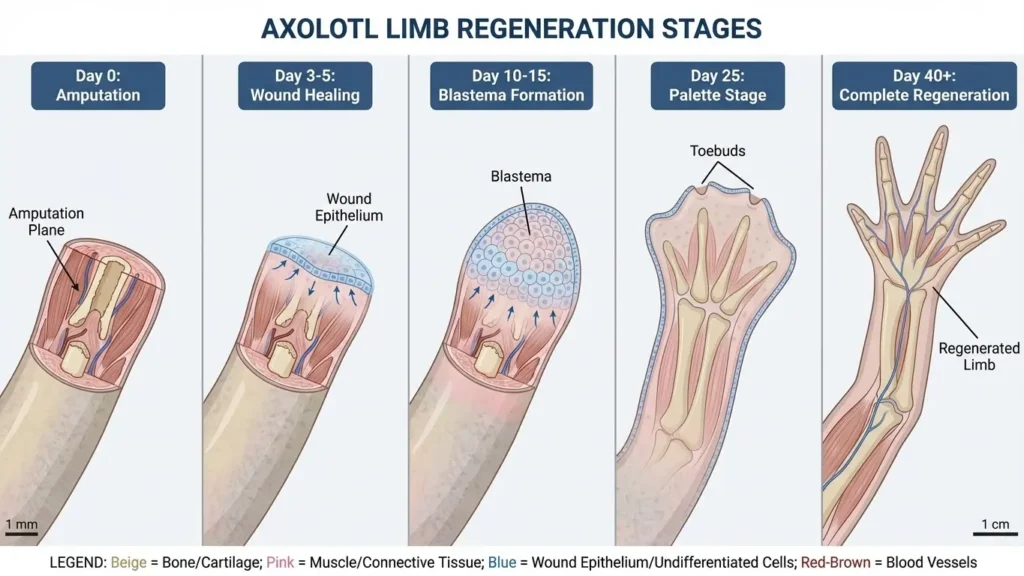
The Blastema: Nature’s Stem Cell Factory
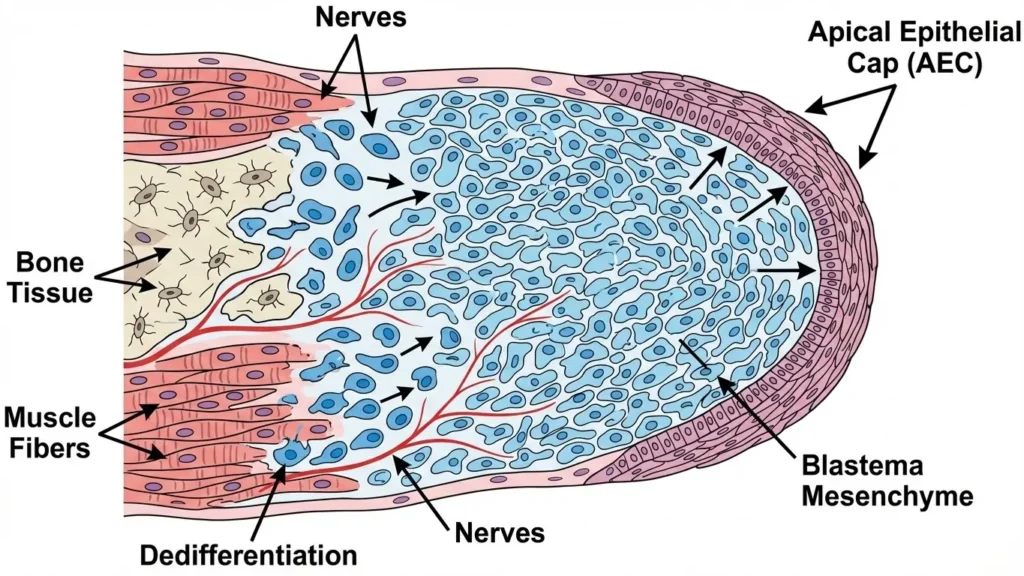
The cornerstone of axolotl regeneration is the blastema, a transient, cone-shaped mass of progenitor cells that forms at the amputation stump.
De-differentiation vs. Progenitor Recruitment
For decades, a central debate in zoology was whether blastema cells were “pre-existing” stem cells or “reprogrammed” mature cells. We now know the truth is a sophisticated hybrid:
- Dedifferentiation: Mature cells, such as dermal fibroblasts and periskeletal cells, undergo a “identity reset.” They revert to an embryonic-like mesenchymal state.
- Pax7+ Satellite Cells: Research updated in late 2024 confirms that while humans have satellite cells for muscle repair, the axolotl recruits Pax7-positive satellite cells with significantly higher efficiency. These cells act as the primary source for myogenesis (muscle growth), ensuring that new muscle fibers align perfectly with the old.
Positional Memory: The Biological “GPS”
A profound mystery of axolotl biology is how a stump “knows” exactly what to regrow. If an axolotl loses a hand, it regrows a hand; if it loses an entire arm, it regrows the arm from the shoulder. This is governed by Positional Information (PI).
The Retinoic Acid and CYP26B1 Gradient
As of 2025, the mechanism behind this “GPS” has been decoded. It relies on a delicate balance of Retinoic Acid (RA).
- Proximal Identity: High concentrations of RA signal the body to build proximal structures like the humerus (upper arm).
- The CYP26B1 Enzyme: In 2024/2025, researchers identified the enzyme CYP26B1 as the “janitor” of regeneration. This enzyme is highly prevalent at the distal tip (the wrist) and destroys RA.
- The Gradient: This creates a chemical slope. High RA at the shoulder and low RA at the wrist tell the blastema cells precisely where they are on the limb’s map.
Information Gain: Using CRISPR-Cas9 to deactivate the Shox gene (shared with humans) has shown that without this specific genetic marker, axolotls can still regenerate, but they lose the ability to correctly “shape” the limb segments, resulting in truncated or malformed appendages.
The Nerve Dependency: The nAG Factor
A critical constraint in urodele biology is that regeneration is nerve-dependent. If the nerves leading to a limb are severed, the blastema will form but then stop growing.
The catalyst is a protein called Newt Anterior Gradient (nAG). Secreted by the Schwann cells surrounding the nerves, nAG acts as the “green light” for cellular proliferation. By artificially introducing nAG into a denervated stump, scientists have successfully “tricked” the limb into regenerating, highlighting a potential pathway for treating human nerve damage.
Bypassing the Scar: Immunological Stealth
The most significant “Semantic Distance” between humans and axolotls lies in the immune response.
- TGF-β Signaling: In humans, the cytokine TGF-β1 dominates the wound site, rapidly triggering myofibroblasts to create a “patch” (scar).
- The Axolotl Shift: Axolotls utilize a high ratio of TGF-β3 (anti-fibrotic) over TGF-β1. This ensures that the Extracellular Matrix (ECM) remains fluid and permissive for cell migration rather than becoming a rigid, scarred barrier.
- Macrophage Modulation: Axolotl macrophages are essential; they don’t just fight infection; they actively clear debris and suppress the inflammatory “storm” that causes scarring in mammals.
While these molecular pathways provide the blueprint for healing, they are deeply tied to the natural habitat and taxonomy of the species, which remains critical for its survival.